

Oregon employers face one of the most layered state payroll tax environments in the country — and 2026 brought at least one significant change most businesses were not prepared for. Payroll Services in Oregon that cover every state obligation accurately are not a luxury; they are the difference between clean quarterly filings and compounding penalties across multiple state agencies. Oregon has state income tax withholding, Paid Leave Oregon, a Statewide Transit Tax that doubled in rate on January 1, 2026, a Workers’ Benefit Fund assessment, and Unemployment Insurance — plus Portland-metro businesses carry TriMet and Lane Transit District taxes on top. The Bookkeeping Company has processed Oregon payroll for Pacific Northwest businesses since 2016.
By Maya Primachenko, Founder · Last updated August 2026
Payroll Services in Oregon: Why Oregon’s Payroll Stack Is More Complex Than Most States
Oregon’s payroll obligations stack up differently from Washington and most other states. Here is what every Oregon employer carries:
- Oregon state income tax withholding. Unlike Washington, Oregon has a state income tax with graduated rates up to 9.9% on income above $125,000 (single filers) for 2026. Employers withhold Oregon income tax based on the employee’s Form OR-W-4 and the Oregon DOR’s withholding tables. Employees who move from Washington to Oregon — or who work for Oregon employers — are often surprised by this additional withholding.
- Paid Leave Oregon (PFMLI). Oregon’s paid family and medical leave program is funded by both employers and employees. The total contribution rate for 2026 is 1% of wages up to the Social Security wage base of $184,500 per employee. Employees pay 60% (0.6%); employers with 25 or more employees pay 40% (0.4%). Employers with fewer than 25 employees are exempt from the employer portion but must still withhold and remit the employee’s share quarterly.
- Statewide Transit Tax — DOUBLED for 2026. The Oregon Statewide Transit Tax rate increased from 0.1% to 0.2% of wages effective January 1, 2026 — the first rate increase since the program launched in 2018. Employers withhold this amount from employee wages and remit it quarterly. Payroll systems that were not updated before January 2026 likely have nine months of undercollection to correct.
- Workers’ Benefit Fund (WBF) assessment. A small per-hour assessment collected from employees and remitted quarterly to Oregon’s Department of Consumer and Business Services. The 2026 rate is approximately 2 cents per hour worked, split between employer and employee.
- Oregon Unemployment Insurance (UI). Employer-paid quarterly tax on wages up to $56,700 per employee for 2026 (increased from $54,300 in 2025). New employer rate for 2026 is 2.4%; experienced employers receive experience-rated rates based on their claim history.
- Portland-area transit payroll taxes. Employers with employees working within the TriMet district pay a TriMet transit payroll tax at 0.8237% of wages for 2026. Employers in the Lane Transit District (Eugene) pay 0.8%. These are employer-paid — not withheld from employees — and are in addition to the statewide transit tax withholding.
What Payroll Services in Oregon Include
Payroll Services in Oregon from The Bookkeeping Company cover every component of a complete Oregon payroll cycle:
- Gross pay calculation — hourly, salary, overtime, bonuses, and any supplemental wages; Oregon minimum wage varies by region (Portland metro area, non-urban counties, and standard rate) and must be applied by the county where the employee works
- Federal withholding — FICA (Social Security 6.2% and Medicare 1.45%) and federal income tax based on Form W-4 elections
- Oregon state income tax withholding — based on Form OR-W-4 and Oregon DOR’s 2026 withholding tables; filed on the quarterly combined payroll tax report
- Paid Leave Oregon contributions — employee share (0.6%) withheld and employer share (0.4% for 25+ employee businesses) calculated and remitted quarterly through Frances Online
- Statewide Transit Tax (0.2% in 2026) — withheld from all employee wages and remitted quarterly
- Workers’ Benefit Fund assessment — per-hour assessment calculated, withheld from employees, and remitted quarterly
- Oregon UI quarterly filing — employer-paid UI contributions on wages up to $56,700 per employee, filed and remitted through the Oregon Employment Department’s Frances Online portal
- TriMet and LTD taxes (Portland and Eugene employers) — employer-paid transit taxes calculated and remitted for employees working within the applicable transit districts
- Direct deposit and pay stub delivery — employee payments processed by ACH and pay stubs delivered digitally
- W-2 preparation at year-end — including Oregon withholding amounts, Paid Leave Oregon contributions, and all other state-specific amounts
The Bookkeeping Company’s payroll services handle the complete Oregon payroll cycle for small businesses — every agency, every quarter, every year-end deadline.
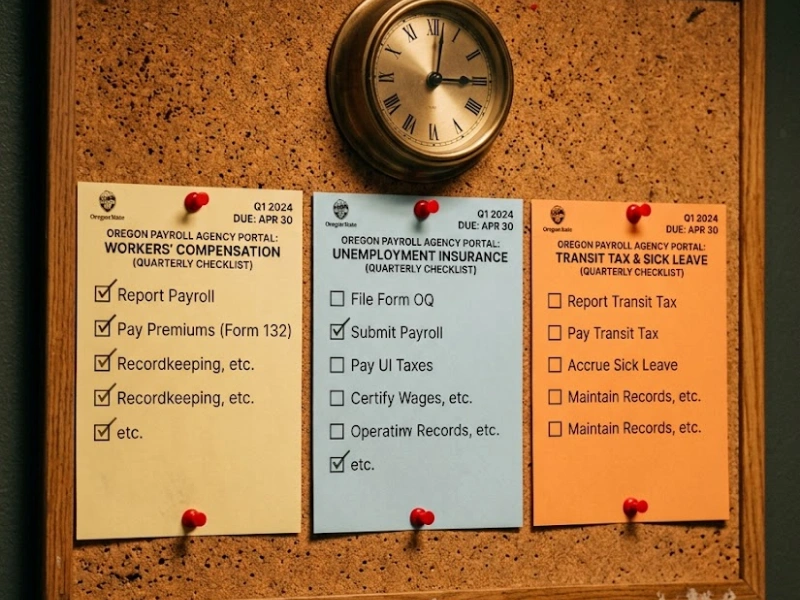
Oregon’s Payroll Tax Requirements: Filing Deadlines Every Employer Must Know
Oregon payroll taxes are filed on multiple schedules through separate agencies. Understanding which portal, which deadline, and which rate applies to each obligation is the core challenge of Oregon payroll compliance:
- Combined Payroll Tax Report (Oregon DOR) — quarterly filing covering Oregon income tax withholding, Statewide Transit Tax, and Workers’ Benefit Fund assessment; filed through Revenue Online by the last day of the month following the quarter end (April 30, July 31, October 31, January 31). (Oregon Department of Revenue)
- Paid Leave Oregon quarterly contributions — filed and remitted through Frances Online (the Oregon Employment Department’s portal) on the same quarterly schedule. Employers with 25 or more employees remit both the employer and employee shares; smaller employers remit only the employee share. (Paid Leave Oregon — Employer Resources)
- Oregon Unemployment Insurance quarterly report — filed through Frances Online; employer-paid; taxable wage base of $56,700 per employee for 2026. New employers pay at the 2.4% rate until they accumulate sufficient claims history for experience rating. (Oregon Employment Department — Employer Taxes)
- Federal 941 quarterly payroll tax deposit — FICA and federal income tax withheld from employees plus employer FICA match; deposited on the IRS semi-weekly or monthly deposit schedule based on prior-period payroll volume. (IRS — Employment Taxes for Small Businesses)
A business that manages its own payroll must monitor at least three separate portals (Oregon DOR Revenue Online, Frances Online, and IRS EFTPS) with aligned but slightly offset deadlines each quarter. Missing a single deadline at any agency triggers separate penalty calculations at each.
How Oregon’s Paid Leave Payroll Deduction Works in 2026
Oregon’s Paid Leave program (officially Paid Leave Oregon) is one of the most comprehensive state paid leave programs in the country — and one of the most frequently misunderstood by employers, particularly those near the Washington border who are more familiar with Washington’s PFML program.
- 2026 rate and wage base. The total Paid Leave Oregon contribution rate is 1% of an employee’s gross wages, up to $184,500 per employee — the Social Security taxable wage maximum for 2026 (increased from $176,100 in 2025). The rate split: employees pay 60% (0.6% withheld from wages); employers with 25 or more employees pay the remaining 40% (0.4% employer-paid).
- Small employer exemption. Employers with fewer than 25 employees are exempt from the employer 40% share — they are only required to withhold and remit the employee’s 0.6% contribution. However, small employers must still register, file quarterly, and remit employee contributions on schedule.
- Leave benefits available to employees. Eligible employees can take up to 12 weeks of paid leave per year for family bonding, serious health conditions, or safe leave situations. The benefit amount is based on a percentage of the employee’s wages relative to the statewide average weekly wage. Employees apply for benefits directly through the Oregon Employment Department — not through the employer.
- How it differs from Washington’s PFML. Oregon’s Paid Leave Oregon and Washington’s Paid Family and Medical Leave are separate programs with different rates, wage bases, eligibility rules, and benefit calculations. Employers with employees in both states must manage both programs simultaneously — and employees cannot receive benefits from both programs for the same leave event.
- Quarterly filing. Employers report Paid Leave Oregon contributions through Frances Online on the combined quarterly report. Contributions are due the last day of the month following the quarter end — the same schedule as Oregon UI but reported on the same system, making Frances Online the single portal for both obligations.
How Much Do Payroll Services in Oregon Cost?
Payroll service costs for Oregon small businesses vary by employee count, pay frequency, and whether Portland-area transit taxes add filing scope. General market rates for full-service outsourced payroll:
- Under 5 employees, biweekly payroll: approximately $150 to $250 per month, including Oregon state filings
- 5–15 employees with Oregon and federal quarterly filings: approximately $250 to $450 per month
- 15–25 employees, Portland-area with TriMet: approximately $400 to $600+ per month, reflecting the additional TriMet employer payroll tax calculation and filing scope
- Year-end W-2 preparation: typically a one-time annual fee per W-2 in addition to the monthly service rate
(Source: SCORE Small Business Resources, 2025.) Oregon payroll complexity — six separate state-level obligations, multiple quarterly portals, and the 2026 Statewide Transit Tax rate change — makes professional payroll more cost-effective relative to DIY than it is in simpler states. Call The Bookkeeping Company at 360-524-9889 for a specific estimate for your Oregon business.

Payroll Services in Oregon: Remote Pacific Northwest Coverage
Payroll Services in Oregon from The Bookkeeping Company are delivered remotely through QuickBooks Payroll and Frances Online — Oregon businesses never need to visit a physical office:
- Portland metro area — Oregon income tax withholding, Paid Leave Oregon, Statewide Transit Tax, TriMet employer payroll tax, and Workers’ Benefit Fund for Portland’s diverse employer community
- Salem and Willamette Valley — state agency employers, agricultural businesses, and professional services firms with Oregon payroll compliance needs
- Eugene and Lane County — businesses subject to the Lane Transit District employer payroll tax in addition to Oregon’s statewide payroll stack
- Bend and Central Oregon — growing business community with Oregon payroll compliance needs and often cross-state operations
- Washington businesses with Oregon employees — Clark County and other Washington employers with remote workers, contractors, or job site employees performing work in Oregon — the most common cross-border payroll scenario for the Pacific Northwest
Located in Vancouver, WA — directly across the Columbia River from Portland — The Bookkeeping Company serves both Oregon and Washington employers with the Pacific Northwest-specific payroll knowledge that a generic national payroll provider cannot match. Oregon payroll integrates directly with bookkeeping services — payroll data flows directly into the monthly books without reconciliation gaps between separate providers.
Need reliable Payroll Services in Oregon that handle every state-specific obligation correctly? Call The Bookkeeping Company at 360-524-9889 for a free discovery call. We serve Oregon businesses statewide — Portland, Salem, Eugene, Bend, and beyond.
Frequently Asked Questions About Payroll Services in Oregon
How much do payroll services cost in Oregon?
Full-service payroll in Oregon typically ranges from $150 to $600 or more per month for small businesses, depending on employee count, pay frequency, and whether Portland-area TriMet or Lane Transit District taxes add filing scope (Source: SCORE Small Business Resources, 2025). Oregon’s six separate payroll tax obligations — each with its own quarterly deadline and portal — mean Oregon payroll costs more than a comparable engagement in a state with fewer payroll layers. Year-end W-2 preparation is billed separately.
What do payroll services include?
Payroll services in Oregon include gross pay calculation, federal FICA and income tax withholding, Oregon state income tax withholding using Form OR-W-4, Paid Leave Oregon contributions for both employer and employee, Statewide Transit Tax withholding (0.2% in 2026), Workers’ Benefit Fund assessment, Oregon UI quarterly filings through Frances Online, direct deposit, and year-end W-2 preparation. Portland metro businesses also need TriMet employer transit payroll tax handled as a separate employer obligation.
What are Oregon’s payroll tax requirements?
Oregon employers must handle: federal FICA (Social Security 6.2%, Medicare 1.45%) and federal income tax withholding; Oregon state income tax withholding (up to 9.9% top rate); Paid Leave Oregon at 1% of wages up to $184,500 (split between employer and employee for businesses with 25+ employees); Statewide Transit Tax at 0.2% of wages (doubled in 2026); Workers’ Benefit Fund at approximately 2 cents per hour worked; and Oregon UI on wages up to $56,700 per employee. Portland employers add TriMet transit payroll tax.
Should I outsource payroll or do it in-house?
Most Oregon small businesses with fewer than 20 employees spend less outsourcing payroll than managing it internally when staff time, payroll software, and quarterly compliance costs are included. Oregon’s six separate payroll obligations — state income tax, Paid Leave Oregon, Statewide Transit Tax, WBF, UI, and federal — each have their own portals and deadlines. Missing a single quarterly deadline at any agency triggers separate penalties. Outsourcing eliminates that risk and frees owner time for revenue-generating work.
How does Oregon’s paid leave payroll deduction work?
Oregon’s Paid Leave Oregon program is funded by a 1% contribution on wages up to $184,500 in 2026. Employees have 0.6% withheld from their wages each pay period. Employers with 25 or more employees contribute an additional 0.4%. Employers with fewer than 25 employees withhold and remit only the employee 0.6% share. Both portions are filed quarterly through Frances Online. Employees can then claim up to 12 weeks of paid leave per year by applying directly to the Oregon Employment Department.
What is the Oregon Statewide Transit Tax and how does it affect payroll?
The Oregon Statewide Transit Tax funds the Statewide Transportation Improvement Fund. Effective January 1, 2026, the rate doubled from 0.1% to 0.2% of wages — the first increase since the program started in 2018. Employers withhold 0.2% from employee wages and remit it quarterly through the combined payroll tax report filed with the Oregon DOR. Employers in the Portland TriMet district separately pay an employer TriMet transit payroll tax of 0.8237% (employer-paid, not withheld from employees) on wages of employees working within the district.
How do I run payroll for my Oregon business?
To run Oregon payroll: register with the Oregon Employment Department for UI and Paid Leave Oregon accounts through Frances Online; obtain a Business Identification Number from the Oregon DOR for income tax withholding; collect Form OR-W-4 from every employee; configure payroll software with Oregon-specific rates for all six payroll obligations; and file the quarterly combined payroll tax report covering income tax, STT, and WBF. Paid Leave Oregon and UI are filed separately through Frances Online on the same quarterly schedule. Most Oregon businesses use QuickBooks Payroll or outsource to a provider with Oregon experience.
Does The Bookkeeping Company handle payroll for Oregon businesses?
Yes. The Bookkeeping Company handles payroll processing for Oregon businesses statewide, delivered remotely via QuickBooks Payroll and the Frances Online portal. Services cover Oregon state income tax withholding, Paid Leave Oregon contributions, Statewide Transit Tax (at the 2026 doubled rate of 0.2%), WBF assessment, Oregon UI quarterly filings, and year-end W-2 preparation. Portland metro businesses with TriMet or Lane Transit District obligations are fully supported. Call 360-524-9889 to get started.
About The Bookkeeping Company
The Bookkeeping Company: Tax Strategies & Planning
18523 NE 65th St
Vancouver, WA 98682
Phone: 360-524-9889
Email: thebookkeepingcomp@gmail.com
Service Area: Serving Oregon businesses statewide and all 50 U.S. states. All payroll processing delivered remotely via QuickBooks Payroll and secure document portal.